
Introduction
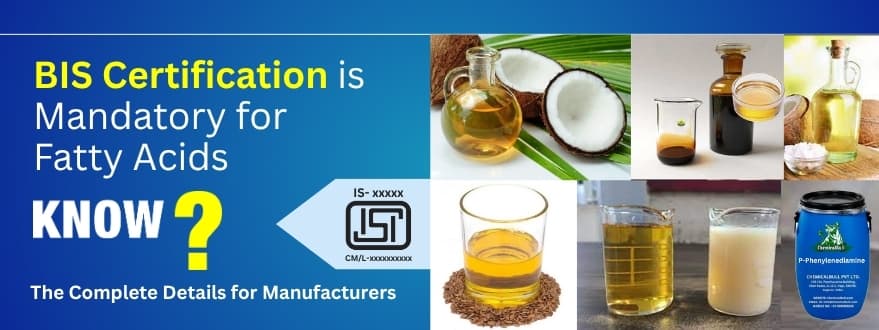
Fatty acids are widely used in industries from cosmetics and food to pharmaceuticals and textiles. Due to its diverse applications and possible impact on health and safety, the Government of India has made BIS certification for fatty acids mandatory. This control measure makes sure that only the best, secure as well and standardized products enter the Indian market. To understand the importance of Mandatory BIS Certification of Fatty Acids, why it must be conducted, what is the BIS Certification process for fatty acids and what documents are required in the process, how manufacturers can enhance their products by relying on qualified expertise and what other assistance India like a BIS Consultant like Brand Liaison can provide will be considered in this blog.
Why Is BIS Certification Mandatory for Fatty Acids?
The Bureau of Indian Standards (BIS) is a ministry of Consumer Affairs, which falls under Food and Public Distribution, and is an organization that compels various products to ensure their safety, performance, and adherence to Indian standards. Fatty acids, particularly those of industrial grade, would require compliance with Indian Standard IS 12029:1986, which is the registered Indian Standard of this type.
The Mandatory BIS Certification for Fatty Acids is necessary because:
- Fatty acids find sensitive applications in the fields of cosmetics, food processing, pharmaceuticals, and lubricants.
- Other safety risks may be contamination, irritation of the skin, and the formation of fatty acids.
- The result of regular certification is quality and safe handling of fatty acids in the consumer and industrial markets.
Understanding BIS ISI Certification for Fatty Acids
The BIS ISI Certification for Fatty Acids refers to the certification provided by BIS under its ISI Mark Scheme. ISI is the abbreviation of Indian Standards Institute, and ISI means quality of mark, safety, and reliability. All manufacturers have to acquire this certificate prior to marketing or selling their fatty acids in India. The ISI mark license gives assurance to consumers and businesses that the product has gone through the test and that it has attained the required standards of purity, quality, and performance.
List of Fatty Acids Covered Under ISI Mark Scheme
Various kinds of fatty acids are now obliged to be certified with the specific Indices of Indian Standard (IS codes) made by the Bureau of Indian Standards (BIS). These contain ordinary industrial fatty acids, such as Lauric Acid, Acid Oil, and Palm Fatty Acids, and more specialized ones, such as Hydrogenated Rice Bran Fatty Acids and 1,3-Phenylenediamine. The list of products that fatty acids fall under the mandatory BIS certification regime with their IS numbers is given in detail below.
| S. N. | Indian Standard (IS) Number | Product Name |
| 1 | IS 10931:1984 | Lauric Acid |
| 2 | IS 10931:1984 | Acid Oil |
| 3 | IS 12067:1987 | Palm Fatty Acids |
| 4 | IS 12068:1987 | Rice Bran Fatty Acids |
| 5 | IS 12069:1987 | Coconut Fatty Acids |
| 6 | IS 12124:1987 | Rubber Seed Fatty Acids |
| 7 | IS 12361:1988 | Hydrogenated Rice Bran Fatty Acids |
How to Get a BIS Certificate for Fatty Acids?
The BIS Certification Process for Fatty Acids involves several detailed steps that ensure a rigorous quality check before granting the ISI Mark License:
Submit application
Manufacturers must apply through the Manakonline portal. This includes filling out Form V, paying the applicable fee, and uploading initial documents.
Document review
The BIS officer will review the documents submitted to verify the validity of the manufacturing unit and ensure that all the necessary data is provided.
Factory audit
A team of BIS inspectors operates the on-site audit of the manufacturing unit to evaluate production processes, quality control measures, and testing capabilities.
Sample test
Fatty acids samples are collected during audit and testing in BIS-recognized laboratories as per 12029: 1986 standards. The products must complete all quality benchmarks to move forward.
ISI mark license grant
If the samples pass all the tests and the manufacturing unit comes from BIS compliance, the license to use the ISI mark is granted.
Monitoring and renewal
The BIS regularly inspects certified units to ensure continuous compliance. The license is valid for a specific period and should be renewed from time to time.
Required Documents for ISI Mark Certification for Fatty Acids
Manufacturers need to submit a comprehensive set of documents to obtain the BIS certification. Below is a list of required documents for BIS Certification for Fatty Acids:
- Factory registration certificate
- Manufacturing process flow chart
- Details of quality control staff and equipment
- Calibration certificates of lab instruments
- Authorized Indian Representative (AIR) agreement (for foreign manufacturers)
- Product test report from in-house or BIS-recognized lab
- Proof of payment of application and processing fees
- Layout plan of the manufacturing unit
- Raw material details and supplier information
Proper documentation is critical to avoid delays or rejections during the certification process.
The Role of a BIS Consultant in India
Navigating the certification process can be challenging for new or foreign manufacturers. That’s where a BIS Consultant in India plays a crucial role. Consultants like Brand Liaison offer end-to-end services including:
- Documentation support
- Contact with BIS officials
- Timing factory audit
- Coordination with test laboratories
- Renewal and monitoring compliance
Engaging with a BIS consultant reduces errors and increases the chances of a successful and timely authentication.
Benefits of ISI Mark License for Fatty Acids Manufacturers
Securing the ISI Mark License for Fatty Acids brings several advantages:
- Market Access: Only BIS-certified fatty acids can be sold legally in India.
- Consumer Trust: The ISI mark assures buyers of safety and quality.
- Competitive Edge: Certification distinguishes your product from uncertified competitors.
- Regulatory Compliance: Avoid penalties and legal issues due to non-compliance.
- Global Recognition: BIS is an internationally recognized body that adds value to exports.
Conclusion
Mandatory ISI Certification for Fatty Acids is an important compliance step for manufacturers with the aim of serving the Indian market. Manufacturers should seek BIS ISI authentication for fatty acids to ensure competitive and legally operational products. The BIS certification process for fatty acids may appear complex, but with proper documentation and expert assistance from a reliable BIS consultant in India, such as Brand Liaison, it becomes a smooth journey.









Share Your Views
Add a Comment