
TEC Certificate Registration
For Telecom Products
Approvals for the Indian market
Check Your Eligibility 
See how much effort you'll need for your certification journey.
Download GuideBook
Get the knowledge about the process , required documents & timelines about the certifications
What is a TEC Certificate?
The TEC Certificate is a mandatory certification for certain notified Telecom and ICT equipment before selling in the Indian market. It is issued by the Telecommunication Engineering Centre (TEC), under the Ministry of Communications, and ensures that the products follow the essential RF Frequency parameters, technical requirements, safety, and interoperability standards, in accordance with the Indian Telegraph Rules, 2017. The TEC Certification is a necessary requirement for all manufacturers (Indian and foreign) of certain telecom products which are notified under TEC Applicable Product Checklist.
Note:
TEC certification is also commonly known as a TEC license, TEC registration and TEC Certificate Online Registration.
Who Needs a TEC Certificate?
All manufacturers (Indian and foreign) who are producing the notified telecommunication products to sell in India are required to obtain a TEC registration before selling their products in the Indian market. Please refer to the applicable product checklist to confirm the applicability for TEC Certification.
Indian Manufacturers to sell in India
TEC Certification is a mandatory requirement for Indian manufacturers who are producing notified telecommunication products before selling them in the Indian market. For ensuring legal compliance, TEC Registration for Indian manufacturers is an essential requirement in India.
Foreign Manufacturers for Export to India
Foreign Manufacturers who want to export notified telecom products to India should get the TEC Certification first. It is mandatory to obtain the TEC Certification before exporting the products to the Indian market. However, they have to appoint an Authorized Indian Representative (AIR) to proceed with the application. You should talk to our team of experts or your consultant for the same.
Guidelines for Importers and Traders
Importers and traders cannot apply directly for TEC Registration, as the TEC license is granted only to the actual manufacturer of the product (whether an Indian or foreign manufacturer). However, importers must ensure that the foreign manufacturer whose products they are importing has a valid TEC Registration for export to India. A copy of the TEC license can be obtained from manufacturers to ensure legal compliance for the Indian market. So, traders and importers are advised to request their respective manufacturers to provide the TEC Certification to sell the products in India.
Mandatory Products Under TEC Certification India
Loading For You
Standard Costing and Timeline
Costing for TEC Certification india
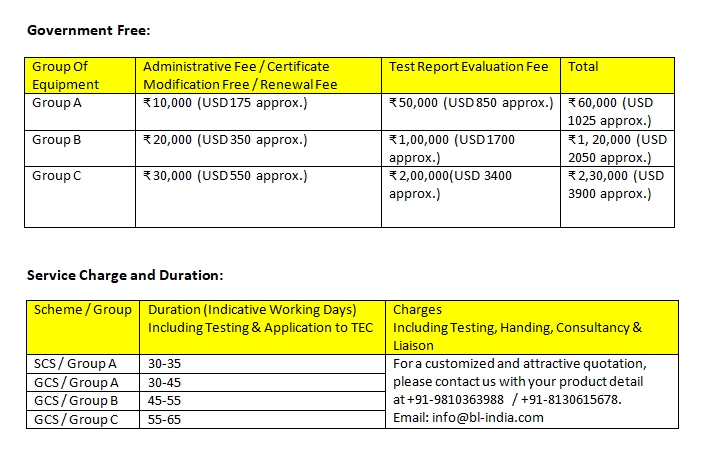
The prices may vary according to the product categories.
📞 Contact us today to receive a cost estimate for your TEC Certification.
Standard Timeline for TEC Certification Services
TEC Certification can be obtained in approximately 1-2 months
How to Get the TEC Certification?
Required Documents for TEC Registration
The TEC certificate can be easily obtained if manufacturers are able to fulfil the documentation requirements and complete the application for TEC approval. The list of documents required for TEC Certification is as follows:
- Trademark/ Brand Registration Certificate
- Factory address proof
- Lab test reports of the product
- Technical Details of the product & User Manual
- Appointment of AIR (Authorized Indian Representative) in case you are a foreign manufacturer
Note:
You can appoint Brand Liaison as your AIR
Procedure for Obtaining a TEC Certification
Follow the given steps to complete your TEC Certification process:
Preparation of the Documents
The applicant should prepare the documents as per the prescribed checklist.
Product Testing
The product sample of the lead model will be tested in TEC-accredited laboratories, as per relevant standards.
Submission of the Application
The applicant needs to submit the application along with the test report and fees to the TEC authorities to initiate the certification process.
Grant of TEC Certification
After verifying the details, credibility, and test report, the TEC Certification will be granted to the applicant.
Other Important Guidelines About TEC Certification
1. Mandatory Testing & Certification of Telecommunication Equipment (MTCTE)
The MTCTE scheme was established by the Department of Telecommunications (DoT) under the Ministry of Communications, Government of India. The objective of this scheme is to maintain the safety and quality standards of the telecom equipment and ensure that they operate at a radio frequency that does not interfere with the existing frequencies. Manufacturing and selling of telecom equipment that conforms to the regulations of this scheme ensures the safety of the end-users and promotes innovative technologies of the telecom infrastructure. The MTCTE scheme ensures that the telecom equipment meets the Essential Requirements (ERs) as prescribed by TEC. To maintain the standards of the telecom equipment, the telecom equipment goes through rigorous testing and evaluation by the TEC authorities.
2. Types of Voluntary Certification Schemes Under TEC
According to the specifications of the product and technical requirements, TEC has several voluntary certification schemes. The notified telecom products are certified under this scheme based on the testing requirements as established by the TEC.
Given below are the different categories of Voluntary Certification Schemes covered in TEC :
- Type Approval
Type Approval is a type of voluntary scheme under which the testing and certification of telecom products are done per the Test Schedule & Test Procedure (TSTP) under TEC in conformity with the Generic Requirements (GRs). The testing under this scheme is done in a laboratory or at the premises of an Original Equipment Manufacturer (OEM). - Interface Approval
It is a type of Voluntary certification scheme in which the testing and certification of the telecom equipment is carried out as per the Test Schedule & Test Procedure (TSTP) under TEC in conformity with the Interface requirements (IRs). The testing is done at the OEM’s premises or in a certified lab environment. In some cases, the Interface Approval is considered a compulsory certification by the service providers or Government organisations. - Certificate of Approval
The process of testing and certification as per the manufacturer’s requirements and specifications comes under this voluntary certification scheme. Under this scheme, the testing is done in the absence of a Generic or Interface Requirement of the telecom product. Following the Test Schedule & Test Procedure (TSTP) under TEC, the testing is done in an OEM’s location or a lab. - Technology Approval
It is a process of testing and certification of a prototype of a telecom product, which is created by the Centre for Development of Telematics (C-DoT) or other R&D entities. Technology Approval is granted by the TEC in accordance with the standard of the product, which was previously issued as the Generic Requirements (GRs). The testing under this approval is conducted either at the facility of an OEM or in an accredited lab.
3. Validity and Renewal
Validity of TEC Approval Certificate
The validity of TEC Certification is ten years, starting from the date of issuance in the case of both Foreign OEMs and domestic manufacturers, until the expiration of the Memorandum of Understanding (MOU) or the AIR (Agreement for Import of Restricted Items) letter, whichever occurs first.
Renewal of TEC Certificate Online
- Submit your renewal application online and the renewal fee at least 1 month before the current certificate's expiration date.
- The certificate can be renewed if there are no alterations in the Essential Requirements (ERs) applicable to the equipment and there have been no changes to the equipment model.
- Upon approval, a new certificate, valid for five years, will be issued with the previous certificate number referenced.
- TEC reserves the right to request re-testing or re-evaluation of certified telecom equipment and levy the appropriate fee, if necessary, to verify the equipment's compliance with the ERs.
4. Groups and Schemes in TEC
Groups in TEC
There are 3 groups established by the Telecommunication Engineering Centre (TEC) according to the duration of testing and evaluation of test reports. These groups are known as Group A, Group B, and Group C. These groups are created as per the testing requirements and duration to manage them effectively. To streamline the procedure of testing and test report evaluation, these groups are given a specific timeline.
Schemes in TEC Registration Services
Two certification schemes are established under the TEC for the telecom equipment to meet certain requirements. They are explained below:
- General Certification Scheme (GCS)
Under the GCS, applicants are mandated to submit test reports conforming to the standards and meeting Essential Requirements (ERs) under the TEC scheme. These test reports must be verified by a Conformance Assessment Body (CAB). The types of equipment that fall under Group A, Group B, and Group C are put under the GCS to enable a comprehensive assessment that complies with the regulations. - Simplified Certification Scheme
Under the Simplified Certification Scheme (SCS), applicants must submit a compliance sheet along with a Self-Declaration of Conformity (SDoC) indicating specifics of Essential Requirements (ERs). Telecom equipment under Group A falls under this scheme. Unlike GCS, test reports from CAB are not a mandatory requirement under SCS.
For further information, kindly refer to the Group Chart: ( View / Download )
5. Prior Requisition for TEC Approval Certificate
Prior requisition is a crucial step in the TEC Certification process, ensuring that the necessary individuals are authorised to carry out TEC-related responsibilities. Depending on the origin and structure of the OEM (Original Equipment Manufacturer), the process differs as follows:
TEC Certificate for Indian OEMs
In the case of Indian OEMs or brand owners, any executive representing the company needs to be designated as an Authorised Signatory. This authorisation is granted through an Authorisation Letter issued by the company, which allows the executive to take on TEC-related responsibilities.
TEC Certificate for export to India for foreign OEMs
Foreign manufacturers operating in India must nominate an Indian business organisation to act as their Authorised Indian Representative and Signatory (AIR). The AIR is responsible for managing TEC-related tasks on behalf of the foreign OEM. This representative should be an executive of the Indian organisation. Following this leads to easy compliance management and availability of a TEC approval certificate for export to India, for businesses dealing across the globe, aiming to enter the Indian market.
Note:
If foreign OEMs do not have an existing arrangement for an AIR, a Brand Liaison can become their Authorised Indian Representative.
6. Placing the TEC Certificate Logo
Here are the key labelling requirements for TEC certification in India:
- The TEC logo should be prominently placed on the body of the telecommunications equipment.
- Besides being physically labelled on the equipment, there should also be an indication in the technical document of the equipment that it conforms to the specified ERs.
- For mobile handsets and tablets, a certification e-label will be applicable.
- The size of the TEC logo can be adjusted, either reduced or enlarged, while maintaining the aspect ratio.
Note:
TEC has exempted product labelling for the initial 6 months, providing manufacturers with a grace period to ensure compliance with the labelling requirements of TEC certification.
To know more, kindly refer to the TEC Labelling Guidelines: ( View / Download )
7. Modification for TEC Registration Certificate
A certificate for certified telecommunications equipment may need to be changed in specific situations. Retesting may or may not be necessary, depending on the type of change and whether it impacts the equipment's compliance. The following is a breakdown of the two types of certificate modification:
Without Re-Testing:
Any modification of certified equipment, which does not present compliance issues with an approved Essential Requirement, will be accepted without retest, provided that the equipment is still in satisfactory working condition.
The following are some of the changes to consider:
- An alteration in size, shape, colour, or enclosing of the equipment that numbered or named the equipment a different model or name.
- Model number changes that do not impact the hardware design.
- Changes in the ownership, corporate structure, or address of the company holding the certificate for the equipment.
- Inclusion of the name of a new Associated Model not originally mentioned on the existing certificate, but covered by the Bill of Materials (BoM) already submitted.
With Re-Testing:
Any other modifications to the certified equipment that affect its compliance with approved Special Requirements will require the issuance of a new certificate.
Here are some examples (not limited to those listed below) of such changes:
- Addition of a new network interface card.
- Alterations to the existing network interface card.
- Inclusion of a new Associated Model not initially referenced on the existing certificate or covered by the BoM of the certified model.
- Incorporation of a new chassis, interface module, or unit in the family of already certified equipment.
- The modified equipment may only be sold or used after TEC issues a new certificate.
Software changes, whether major revisions, minor revisions, patches, bug fixes, or updates, do not inherently necessitate a certificate modification unless they result in non-compliance with Essential Requirements to which the equipment had previously adhered. The OEM is responsible for determining this and applying for certificate modification if required.
8. NC and Contraventions
Non-compliance (NC) and contraventions of the TEC registration certificate requirements set by the Telecommunication Engineering Centre (TEC) are taken seriously, and the following actions are implemented:
- If TEC identifies uncertified equipment, equipment with unauthorised modifications, or equipment whose certification is about to expire, being sold, used, or intended for sale, such equipment will be required to go through the necessary certification process within 180 days from the date of the violation notification.
- The fees charged will be ten times more than what is prescribed before granting the certification.
Note:
If the TEC registration certificate is not obtained for such equipment within the specified time frame, TEC reserves the right to seize and dispose of all such equipment.
If any licensed entity is using uncertified equipment or not taking any action against the use of uncertified equipment:
- A notice of violation will be issued by the authorities to stop the use of uncertified equipment with immediate effect.
- Actions will be taken as per the license conditions.
- However, mandatory certification will be allowed for a period of 180 days from the date of issue of the notice of violation, and ten times the prescribed fees will be charged before granting the certificate.
Note:
Unlawful use of certification shall be a criminal offence for which the penal provisions of the Indian Penal Code will apply.
9. NCCS Security Certification
NCCS stands for the National Centre for Communication Security, which is a Centre under the Department of Telecommunications (DoT). This centre is responsible for implementing the Communication Security Certification Scheme (ComSec). The scheme ensures mandatory testing and certification of the telecom equipment before it is sold in the Indian market. The testing and certification ensure that the telecom equipment meets the essential requirements (ERs) as implemented by the TEC. The testing of the telecom equipment ensures that the product conforms to the national and international quality & safety requirements. Once these products meet the testing requirements, the TEC Certification is issued for these products.
The National Centre for Communication Security ensures the implementation of the ComSec scheme in the following ways:
- Ensuring that the Telecom equipment meets safety and security requirements.
- Establishing a framework of testing and certification.
- Formulation of operational processes, standard protocols, and technical specifications.
- Maintaining conformity with the regulatory norms and testing requirements set by the authorities.
To get further assistance, please contact Brand Liaison.
What will happen if you are selling products without TEC Certification?
TEC Certification is a mandatory approval for notified telecom equipment in India, which is governed by the Telecommunications Act, 2023, and implemented through the MTCTE (Mandatory Testing and Certification of Telecommunication Equipment) Scheme. The framework empowers the Government and DoT to set mandatory standards, enforce testing, prohibit unsafe equipment, and ensure telecom network integrity.
For Foreign Manufacturers
If you are exporting the notified products in the Indian market without a TEC certification, there might be various risks, such as:
- No custom clearance
- Financial losses
- Loss of market opportunities
- Product seizures
For Indian Manufacturers
If you are selling the notified products in the Indian market without a TEC certification, there might be various penalties such as:
- Confiscation of uncertified equipment
- Fines up to ₹50,000 for first violations, up to ₹2,00,000 for repeated violations
- Additional ₹50,000 per day for continuing breaches
- Higher graded penalties ranging from ₹1 lakh (minor) to ₹5 crore (severe)
- Suspension or revocation of approvals
- Personal liability of directors/officers
- Potential criminal prosecution for serious or deliberate violations
Visit here for the complete Legal Aspect of the TEC Certification in India.
How Brand Liaison Will Help You?
Brand Liaison is a trusted and reliable compliance expert who provides manufacturers and importers with end-to-end regulatory support for approvals and certifications in India. We offer professional services such as BIS Certification, ISI Marking, BEE Certification, TEC certification services, WPC/ETA Certification, EPR Registration, LMPC Registration, and other regulatory compliances with:
- Practical solutions for compliance management
- End-to-end regulatory support to avoid delays
- Cost-effective guidance
- Expertise backed by excellent industry experience
- Simplified documentation
- Technical Assistance
- Coordination with authorities and timely follow-ups
- Support in factory audits and inspections
- Regular industry updates
The above-mentioned features make Brand Liaison a reliable TEC Certification consultant for manufacturers, importers, and brands looking for smooth and hassle-free compliance. Get in touch today for smooth and worry-free approvals.
FAQs on TEC Certification
Who provides a TEC certificate?
What is the MTCTE?
Which labs can be used for testing?
What happens if I sell a product without TEC certification?
Can foreign manufacturers apply for TEC Certification?
What are the TEC online certification services?
What are the Charges for a TEC Certificate?
Why should I hire a TEC certification consultant?
Who is the best TEC agent for export to India, helping foreign businesses?
Check Your Eligibility
See how much effort you'll need for your certification journey.
Download GuideBook
Get the knowledge about the process , required documents & timelines about the certifications
Other certifications you may need
.webp&w=256&q=75)


Testimonials
What our client says

Brand Liaison is a trusted partner for all our certification needs. Their expert team made the complicated compliance process simple and stress-free. Professional, reliable, and highly efficient.

Sylvester Adams

Our experience with Brand Liaison has been outstanding. From start to finish, their consultants managed everything with precision. The professionalism and expertise of their team are truly commendable.

Pratibha Mukhija

Brand Liaison has an excellent team of experts who know the compliance field inside out. Their commitment, transparency, and professional service make them stand out from others.

Ashish Banerjee

We were struggling with BIS certification until we connected with Brand Liaison. Their knowledgeable team guided us with accuracy and patience. Excellent service and very professional staff.

Christina Gomez

The expertise of Brand Liaison’s consultants is evident in how quickly and efficiently they work. They saved us time, effort, and unnecessary stress. Highly recommended for compliance services.

Varun Shukla

What impressed us most about Brand Liaison is their professional approach and in-depth knowledge. The team is always available to answer queries and provide reliable guidance throughout the process.

Sanchi Gupta

We trusted Brand Liaison with our BEE certification, and they delivered perfectly. Their expert handling of documentation and testing was seamless. A great team with unmatched professionalism.

George Jacob

Brand Liaison made the entire certification process smooth and simple. Their team explained every step clearly and handled all requirements with complete professionalism. Truly experts in their field.