
Introduction
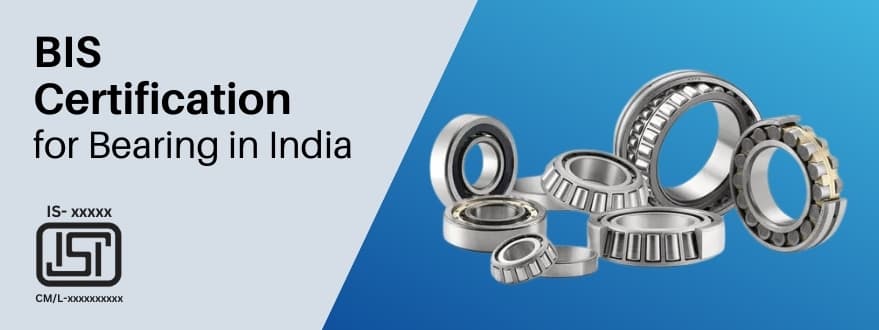
The industries as well as commercial sectors are expanding rapidly, and the need to attain certified products for everyday industrial uses and applications is all the more important. Products like bearings are being rigorously demanded across various industries, as the use is versatile and the need is diversifying with the increasing demand for the same. Being an essential component for a variety of purposes, the use of bearings is increasing.
Abiding by the necessary market compliances, such as getting the mandatory BIS certification for Bearings, is important for manufacturers and importers of such products to stay compliant and ahead in the Indian market.
What is BIS Certification for Bearings?
BIS certification is a mandatory certification requirement for notified products in the Indian market through which the Bureau of Indian Standards (BIS) verifies that a product conforms to the applicable Indian Standard and certification requirements.
For bearings that have been covered under a mandatory Quality Control Order (QCO), manufacturers must obtain the applicable BIS licence and use the ISI Standard Mark as permitted before selling or importing the product in the Indian market. The exact requirement generally depends on the bearing type and the Indian Standard specified for it.
It is therefore important to first identify the exact bearing category, applicable IS standard and current QCO status before beginning the certification process.
What is the Importance of BIS Certification for Bearings?
Bearings are commonly used mechanical components that can be suited for diverse applications in the industry. These are essential for reducing friction and supporting a smooth and unobstructed motion in a variety of machines and devices. These can effectively transfer loads from various components and are essential products being widely used and demanded in sectors such as household, aerospace, automotive, etc.
As the use of these devices seems nowhere to decline in the near future, it is essential for businesses dealing with these products in the Indian market to abide by the regulatory requirements and comprehensively understand BIS ISI Mark certification in detail for bearings. By thoroughly testing and verifying them on various safety and performance parameters, it is ensured that they are following the stringent market regulations and are compliant for sales and trade. Legal consequences are also prevented when BIS certification is obtained for the notified products.
Understanding the Quality Control Order for Bearings 2025
The BIS has issued a QCO that is named the Bearings (Quality Control) Order, 2025. As per this Order, there are certain products listed that have to bear the BIS ISI mark and conform to the IS specifications mentioned for each of them. The Bureau of Indian Standards will remain the enforcing authority, and businesses that contravene this order can face various fines and penalties under the provisions of the Bureau of Indian Standards Act, 2016. Therefore, businesses dealing with the notified products in India must completely understand the provisions of the BIS QCO 2025 for Bearings.
Process to Get BIS Certification for Bearings
Gaining a BIS certification for bearings involves an easy process. Here are several steps that businesses have to follow:
- Apply on the official BIS Manakonline portal.
- The important documents and details have to be submitted along with the application.
- Products have to be tested, and test reports of the same have to be provided to the BIS for verification.
- After paying the required fees, the BIS will begin processing the application and ask for any missing details or documents, if any.
- The factory premises will then be thoroughly inspected by the BIS officials and organizations, and manufacturing processes and quality and safety control measures will be checked.
- The product samples will be taken by the BIS officials for testing in the BIS-accredited labs.
- On receiving the test reports and verifying the documentation and all necessary details, the BIS will grant the BIS ISI certification to manufacturers.
However, it is important to note that the process for obtaining a BIS certificate for bearings is different for foreign manufacturers than what is specified for Indian manufacturers. Foreign manufacturers will get the ISI mark for their products through the BIS FMCS Certification scheme.
How Long Does it Take to Get a BIS Licence for Bearings?
The timeline for obtaining a BIS licence for bearings is not fixed because it depends on various factors such as the applicable Indian Standard, product testing, documentation, factory readiness, and BIS assessment.
However, here is an average estimated timeline for getting a BIS certification at BIS technical discretion:
- For domestic manufacturers: 20-40 working days
- For foreign manufacturers: 5-6 months
For a domestic manufacturer, a well-prepared application can progress more efficiently when the factory, testing facilities, as well as the documentation are ready from the beginning.
For foreign manufacturers, the process can require additional coordination, including the appointment of an Authorized Indian Representative and factory assessment under the applicable FMCS procedure.
What Happens if BIS Certification is Not Obtained?
If a bearing is covered under a mandatory BIS certification requirement, manufacturing, importing, or selling it without the required certification can result in regulatory as well as various commercial risks. Potential consequences of non-compliance with the BIS regulatory framework generally include:
- Restrictions on manufacturing or sale
- Regulatory action against non-compliant products
- Seizure or other enforcement measures where applicable
- Financial or legal penalties under the applicable law
- Shipment and supply-chain delays
- Rejection by customers or institutional buyers
- Additional testing and corrective-action costs
- Loss of market credibility
Checking the BIS requirement depends on whether the specific product is covered by an applicable QCO or BIS order. To understand what a product requires to be compliant, it is best that manufacturers begin by checking product eligibility for a BIS certification, to prevent last-minute errors.
How Can Brand Liaison Help With BIS Certification for Bearings?
Brand Liaison helps bearing manufacturers as well as businesses manage the BIS certification process through end-to-end compliance assistance. Here is why businesses prefer to work with Brand Liaison:
- Identifying the applicable Indian Standard and QCO
- Reviewing product scope and specifications
- Preparing BIS application documents
- Guiding manufacturers on testing requirements
- Coordinating laboratory testing
- Preparing the factory for BIS inspection
- Supporting responses to BIS queries and observations
- Assisting foreign manufacturers with applicable requirements
- Expert consultancy and AIR support
- Providing post-certification compliance support
Our approach focuses on identifying the correct certification path before testing and application, helping manufacturers avoid unnecessary delays, documentation gaps, as well as incorrect product classification. Having more than a decade of experience, Brand Liaison has been the top BIS ISI certification consultant in India, assisting businesses with comprehensive compliance management solutions for the Indian market. Call our team of professional consultants today to initiate hassle-free compliance in India.
Conclusion
BIS certification is a mandatory compliance, non-conformity to which can lead to various regulatory risks as well as consequences for businesses selling or importing notified products in India. It is important that businesses involved in dealing with products such as bearings must comply with the necessary market regulations like BIS certification. Getting in touch with the best BIS certificate consultant can surely save a lot of hassle and ensure that you don’t miss any updates.









Share Your Views
Add a Comment