
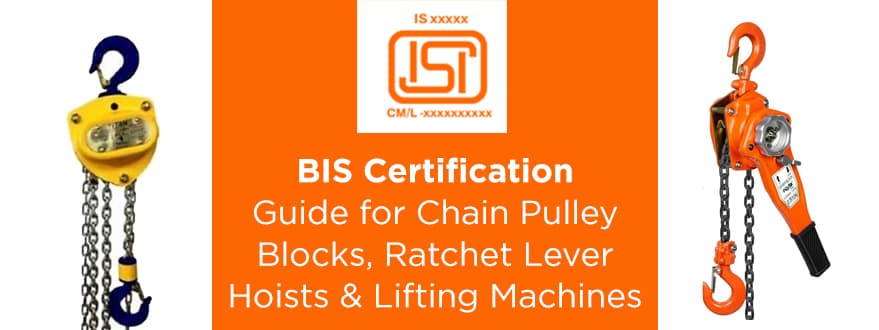
Quick Answer – BIS certification for chain pulley blocks, ratchet lever hoists and universal gearless pulling and lifting machines involves compliance with the relevant Indian Standards. The applicable standards are IS 3832, IS 11340 and IS 5604, respectively. However, manufacturers and importers should verify the latest Quality Control Order (QCO) and its implementation status before assuming certification is mandatory for sale in India. Brand Liaison helps with the BIS ISI certification process and ensures regulatory compliance in the Indian market.
Introduction
Chain pulley blocks, ratchet lever hoists, as well as lifting machines are widely used in construction, manufacturing, warehouses, and industrial material handling to lift or move heavy loads. For manufacturers and importers who are planning to enter the Indian market, understanding the applicable BIS certification requirements is essential for product compliance and business planning. This guide explains the relevant Indian Standards, QCO status, certification process, documentation, and key compliance considerations for lifting equipment in the Indian market.
What Are Chain Pulley Blocks, Ratchet Lever Hoists and Lifting Machines?
Lifting equipment helps industries move heavy loads safely and in an efficient manner. These machines are widely used in manufacturing plants, warehouses, construction sites, workshops and material-handling operations. The three product categories covered in the proposed QCO are:
- Chain Pulley Blocks: Manually operated devices that use a chain mechanism to lift heavy loads vertically.
- Ratchet Lever Hoists: Compact lifting and pulling tools operated using a lever, commonly used where precise positioning and limited space are important.
- Universal Gearless Pulling and Lifting Machines: Devices that are used to pull or lift loads through a wire rope mechanism.
Although these products perform similar functions, their designs and operating mechanisms differ. Therefore, manufacturers must identify the correct Indian Standard for their specific product rather than applying for certification under a general lifting equipment category.
Which Indian Standards Apply to Lifting Equipment?
The applicable Indian Standard depends on the type of equipment being manufactured.
| Product category | Applicable Indian Standard |
| Hand-operated chain pulley blocks | IS 3832:2005 |
| Ratchet lever hoists | IS 11340:2020 |
| Universal gearless pulling and lifting machines | IS 5604:1984 |
Selecting the correct standard is important because it determines the technical requirements, testing parameters, and product conformity criteria that is applicable to the equipment. If you are unsure about the specific Indian Standard, check product eligibility for BIS certification today.
Is BIS ISI Certification Mandatory for Lifting Machines in India?
Yes. The Department for Promotion of Industry and Internal Trade (DPIIT), under the Ministry of Commerce and Industry, has published a draft Quality Control Order concerning chain pulley blocks, ratchet lever hoists, and universal gearless pulling and lifting machines.
The proposed order specifies mandatory conformance with the relevant Indian Standards and the use of the BIS Standard Mark under Scheme-I of the BIS (Conformity Assessment) Regulations, 2018.
The BIS ISI certification is a mandatory compliance requirement for notified products. It is granted by the Bureau of Indian Standards (BIS), which regulates products in the Indian market through various BIS certification schemes. Conforming to the mandatory compliance requirement is important, as non-conformance can lead to penalties and fines.
What Quality and Safety Requirements Should Manufacturers Consider?
Lifting equipment handles substantial loads, so product performance and manufacturing consistency are important considerations. Depending on the applicable Indian Standard, manufacturers may need to address requirements relating to:
- Load-bearing capacity and rated load.
- Functional performance and operating mechanisms.
- Structural strength and resistance to deformation.
- Load chains, wire ropes and other relevant components.
- Inspection and testing procedures.
- Product marking and traceability.
- Production quality control and test records.
The precise requirements vary by product. Manufacturers should consult the applicable standard rather than relying on a generic checklist for all lifting machines. Meeting technical requirements also helps businesses prepare for product testing, factory assessments and any applicable conformity assessment requirements.
A top BIS certificate consultant in India can help businesses smoothly manage BIS compliance in the Indian market.
How to Obtain a BIS ISI Licence for Chain Pulley Blocks and Hoists?
Where certification is applicable, manufacturers can prepare for the BIS ISI licensing process under the relevant conformity assessment scheme. Here are the steps that must be followed to get a BIS certificate online in India:
Step 1: Identify the product and applicable standard
Confirm the product category, intended use, model specifications, and applicable Indian Standard.
Step 2: Review manufacturing and quality controls
Check whether the factory has the necessary production infrastructure, inspection arrangements, testing facilities, and quality control procedures.
Step 3: Prepare product samples for testing
Arrange testing through the appropriate laboratory as required under the applicable BIS procedure. The tests usually depend on the product and relevant standard.
Step 4: Prepare the application and supporting documents
Prepare the required manufacturing, technical, quality control and legal documents. Make sure that product specifications and submitted records are consistent.
Step 5: Complete the factory assessment, where applicable
BIS may check the manufacturing premises, production processes, testing arrangements and quality control systems under the applicable certification scheme.
Step 6: Address any non-conformities
If testing or assessment identifies gaps, the manufacturer must take corrective action and fulfil the applicable requirements.
Step 7: Obtain the licence before using the Standard Mark
The BIS ISI licence is granted only after the applicable requirements have been met. The manufacturer must follow the licence conditions and marking requirements before applying the ISI Mark registration to notified products. Once granted, the applicant can download the BIS certificate and use the Standard Mark on the approved products.
Documents Required for BIS ISI Mark Certification of Lifting Equipment
The documents required depend on the product, manufacturing location, and applicable BIS license procedure. Commonly relevant records include:
- Business registration and manufacturing unit details.
- Factory address and manufacturing process information.
- Product specifications, drawings and model details.
- Details of raw materials and critical components, where applicable.
- Manufacturing machinery and testing equipment lists.
- Quality control procedures and inspection records.
- Test reports and calibration records, as required.
- Authorisation documents and applicable declarations.
- Details of the brand or trademark, where relevant.
Note: Foreign manufacturers may also need to fulfil additional requirements under the BIS FMCS Certification procedure, such as appointing an AIR to proceed with the ISI Mark certification application.
Preparing accurate documents in advance can reduce avoidable application queries and help maintain consistency between the factory records, product samples and application. Top BIS ISI certification consultants in India can reduce last-minute hassles and avoid application errors for smooth BIS compliance.
What is the Cost of BIS Certification for Hoists and Lifting Machines?
There is no single fixed BIS certification cost that is applicable to every lifting equipment certification application. The overall expenditure usually depends on the product category, testing requirements, application scope, and factory readiness.
Potential cost components include:
- BIS application and licence-related fees.
- Product testing and laboratory charges.
- Factory inspection and related expenses, where applicable.
- Sample preparation, transport and documentation.
- Additional testing or corrective action, if required.
- Professional consultancy fees, if assistance is engaged.
Manufacturers should contact the best BIS certificate consultants in Delhi, and know the exact price estimate for a BIS ISI mark certificate for their products.
What Should Indian Manufacturers and Importers Do Before Selling?
Businesses should verify regulatory applicability before manufacturing, importing, or commercialising these products.
For Indian manufacturers:
- Identify the relevant Indian Standard.
- Review the latest QCO and implementation status.
- Evaluate factory readiness and testing arrangements.
- Maintain product quality and traceability records.
For importers and foreign manufacturers:
- Confirm whether the product falls within a notified mandatory category.
- Check the applicable BIS licensing route for the overseas factory.
- Verify the required documents and testing arrangements.
- Review any exemptions and effective dates specified in the final order.
Importers should not assume that a foreign test report or an existing overseas certification automatically satisfies Indian requirements. Businesses should also monitor regulatory updates because the final scope, deadlines and conditions of a QCO may differ from its draft.
Contact the best BIS consultant and ensure seamless BIS compliance for the Indian market.
How Brand Liaison Supports BIS Certification for Lifting Equipment
Understanding Indian Standards, identifying the correct certification route as well as preparing a manufacturing unit for evaluation can be challenging, particularly for businesses entering the Indian market for the first time.
Brand Liaison, being the top BIS ISI certification consultant in Delhi, assists Indian and foreign manufacturers with product compliance planning, applicable standard identification, documentation, testing coordination, factory inspection preparation, and application-related support.
With more than a decade of experience in product certifications and industry expertise, Brand Liaison is known to have completed 1000+ BIS projects, 500+ FMCS certifications, and possesses an ever-expanding clientele across sectors and around the world. Get in touch with our team of expert consultants today.
Conclusion
BIS certification for chain pulley blocks, ratchet lever hoists and universal gearless pulling and lifting machines requires careful identification of the relevant Indian Standard and applicable regulatory route. For manufacturers, importers and businesses that are planning to enter the Indian market, the first step is to verify the latest QCO status and prepare for the applicable technical and certification requirements. Early compliance planning can surely help prevent avoidable delays and support a smoother market entry.









Share Your Views
Add a Comment