
Introduction
Electrical appliances that are used in homes, offices, commercial establishments, as well as similar applications must meet applicable safety and quality requirements before being sold or imported in the Indian market. For manufacturers, importers, and businesses who are dealing in these products, understanding the applicable BIS certification requirements is essential for regulatory compliance.
Many household, commercial, and similar electrical appliances that have been notified by the BIS are subject to mandatory BIS certification in India. Let us understand in detail what the importance of BIS certification for electrical appliances is, what the requirements for a BIS consultant are, and how Brand Liaison helps businesses manage BIS compliance in the Indian market.
What is BIS Certification for Electrical Appliances in India?
BIS ISI certification is a mandatory compliance certification through which manufacturers demonstrate that their products comply with the applicable Indian Standard.
For household and similar electrical appliances, IS 302 (Part 1):2024 / IEC 60335-1:2020 establishes general safety requirements. BIS identifies this standard as Household and Similar Electrical Appliances – Safety Part 1: General Requirements (Seventh Revision).
The BIS ISI certification framework is intended to address safety aspects such as electrical protection, construction, mechanical safety, temperature, insulation, as well as other hazards associated with the operation of electrical appliances. It is a mandatory compliance requirement, and notified products must be certified with an ISI mark to be compliant for sales and imports.
Is BIS Certification Mandatory for Household and Commercial Electrical Appliances?
Yes, for products that have been notified by the applicable Quality Control Order, BIS certification is a mandatory compliance requirement. The Safety of Household, Commercial and Similar Electrical Appliances QCO applies to specified electrical appliances within its scope.
However, an important distinction is that an appliance already covered by another QCO is not covered by this particular QCO. Therefore, manufacturers as well as importers should identify the exact product and check all applicable regulatory requirements before deciding which BIS certification type applies. This product-specific assessment is particularly important for businesses that are dealing with appliances such as electrical cooking equipment, cleaning appliances, heating appliances and other specialised products.
Which Standard Applies to Electrical Appliances in India?
IS 302 (Part 1):2024 covers general safety requirements and constructional details for household and similar electrical appliances. It applies to appliances with rated voltage not exceeding 250 V for single-phase appliances and 480 V for other appliances, including direct-current supplied and battery-operated appliances.
| Requirement | Applicable Standard |
| General safety requirements | IS 302 (Part 1):2024 |
| International reference | IEC 60335-1:2020 |
| Revision | Seventh Revision |
| BIS certification framework | Scheme-I / ISI Mark Scheme |
IS 302 (Part 1):2024 vs IS 302 (Part 1):2008
One of the most important recent developments is the revision of the general electrical appliance safety standard. IS 302 (Part 1):2024 / IEC 60335-1:2020 is the seventh revision and replaced the earlier IS 302 (Part 1):2008 framework. The revised standard also recognises a broader range of appliance configurations, including DC-supplied as well as battery-operated appliances.
Therefore, manufacturers should not continue relying on older IS 302:2008 information without checking the current BIS requirements that are applicable to their product.
What is the Safety of Household, Commercial and Similar Electrical Appliances QCO?
The Bureau of Indian Standards has recently revised the standard IS 302 (Part 1): 2024 / IEC 60335-1: 2020, which now calls for a compulsory BIS certification for the safety of household, commercial, and similar electrical appliances. The directive provides safety requirements as covered by the IEC 60335 series and introduces new testing as well as component standards for the appliances.
To know further regarding the notification for BIS certification, for the safety of household, commercial, and similar electric appliances, read the complete BIS QCO for household, commercial, and similar electrical appliances.
Which Electrical Appliances Are Covered under the BIS QCO?
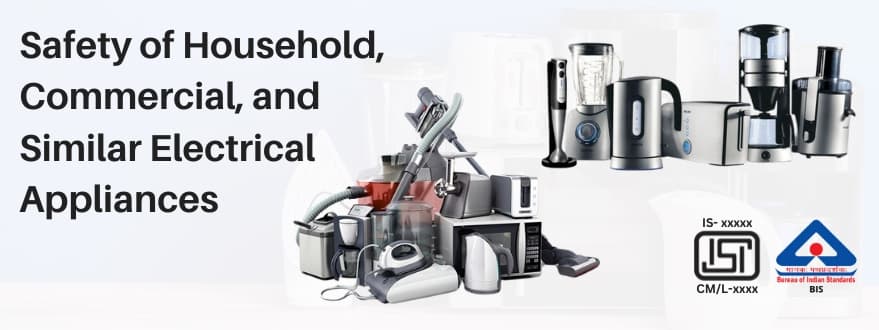
The QCO covers electrical appliances that have been intended for household, commercial, or similar applications within the specified voltage limits. BIS's current compulsory-certification listing includes a broad range of products, such as:
- Vacuum cleaners and water suction cleaning appliances
- Spin extractors
- Cooking ranges, hobs and ovens
- Electric shavers and hair clippers
- Tumbler dryers
- Warming plates
- Frying pans and deep-fat fryers
- Appliances for heating liquids
- Massage appliances
- Electric forced-convection ovens
- Steam cookers and similar appliances
If you are unsure whether your product needs this mandatory certification or not to be compliant in India, check your eligibility for BIS certification today with Brand Liaison’s free CYE tool.
What is the BIS Certification Process for Electrical Appliances?
The BIS certification process generally involves technical assessment, product testing, as well as evaluation of the manufacturing arrangements. Have a look at the following steps:
1. Preparation of the Documents
The applicant should prepare the documents as per the prescribed checklist. For foreign manufacturers, an Authorized Indian Representative (AIR) must be appointed to proceed with the application.
2. Submission of the Application
The applicant needs to submit the application to the BIS authorities to initiate the certification process.
3. Factory Inspections by BIS Officials
The BIS officials will visit the factory to conduct factory inspections to review the manufacturing processes and quality assurance as per BIS Standards.
4. Product Testing
The product sample will be tested in BIS-accredited laboratories, as per relevant standards. The product sample will be decided (chosen) by a BIS officer during the inspection.
5. Grant of BIS ISI Certification
After verifying the details, credibility, and audit report, the BIS ISI certification will be granted to the applicant. They can then download the BIS certificate via the ManakOnline portal.
What are the documents required for BIS Certification?
The exact documentation depends on the product, manufacturer, as well as the certification procedure. Common documents and technical information may include the following:
- Legal address proofs of the factories
- Product specification
- Details of raw material, machinery, and testing equipments
- Details of QC Staff and other basic details of the factory
- Lab test reports of the product
- Main Application Form V
- ISI Application Fee
- Appointment of AIR (Authorized Indian Representative) in case you are a foreign manufacturer
Note: You can appoint Brand Liaison as your AIR. We are the best BIS certification consultant in India, helping businesses with smooth compliance for the Indian market.
BIS Certification for Imported Electrical Appliances in India
Importers and overseas manufacturers should assess BIS applicability before shipping products to India. A practical pre-import check should include the following key considerations:
- Identify the exact appliance and its function.
- Check whether it falls under the applicable QCO.
- Check whether another QCO already covers the product.
- Identify IS 302 Part 1 and any relevant Part 2 standard.
- Verify the BIS requirements for the overseas manufacturer.
- Review testing and documentation requirements.
- Check applicable marking and labelling requirements.
- Verify current QCO implementation and transition provisions.
This early assessment can help prevent situations where goods are manufactured or shipped before the necessary Indian compliance requirements are addressed.
Common BIS Compliance Mistakes to Avoid
Manufacturers as well as importers can face unnecessary delays when electrical appliance compliance is assessed only after production or shipment. Common mistakes include:
- Assuming every electrical appliance follows the same BIS route
- Using outdated IS 302:2008 information
- Ignoring the transition to IS 302 (Part 1):2024
- Failing to check applicable Part 2 standards
- Overlooking another QCO that may already cover the product
- Testing a product configuration that differs from the production model
- Providing inconsistent technical documentation
- Ignoring component requirements
- Using the BIS Standard Mark without the required licence
- Checking QCO implementation dates too late
A product-specific compliance assessment before manufacturing or import is therefore recommended. Brand Liaison, the best BIS certification consultant in Delhi, India, can help businesses with simplified compliance management for the Indian market.
How does Brand Liaison assist with BIS Certification in India?
Brand Liaison supports manufacturers, importers, as well as businesses with BIS certification for products that are entering the Indian market. For electrical appliances, our team assists with BIS applicability, applicable Indian Standards, product testing, technical documentation, application filing, and complete certification procedures.
We have 10+ years of experience in regulatory compliance, helping businesses with comprehensive product certification support for the Indian market. Brand Liaison provides practical end-to-end support to help businesses understand requirements and navigate the BIS certification process in an absolutely efficient manner. Get in touch with our team of expert professionals today.
Conclusion
BIS compliance for household, commercial and similar electrical appliances is not a common certificate requirement. Manufacturers and importers must first identify the exact product category, applicable QCO, IS 302 (Part 1):2024 requirements and relevant Part 2 standard, while also checking whether another QCO already governs the product.
Businesses that are planning to manufacture, import or sell electrical appliances in India should check compliance before production or shipment, rather than waiting until certification becomes an immediate requirement. Early evaluation of standards, testing, documentation, as well as product variants can help reduce delays and avoid costly compliance issues.








Share Your Views
Add a Comment