
Introduction
Reinforcement couplers join steel reinforcement bars in concrete structures without actually relying only on lap splicing or welding. They create mechanical connections and are absolutely useful where space, bar diameter, construction speed, or structural requirements make conventional splicing a lot more difficult.
For manufacturers who are supplying these products in India, quality as well as conformity are important because a coupler becomes part of a reinforced concrete system. BIS has developed IS 16172:2023, “Reinforcement Couplers for Mechanical Splices of Steel Bars in Concrete - Specification,” in order to define requirements for these products. Businesses involved in the sale, production, or import of these goods must necessarily obtain a BIS certification for reinforcement couplers.
This guide explains the ISI mark certification in detail, including the standard, testing, process, documents, compliance considerations, as well as professional support.
What are Reinforcement Couplers?
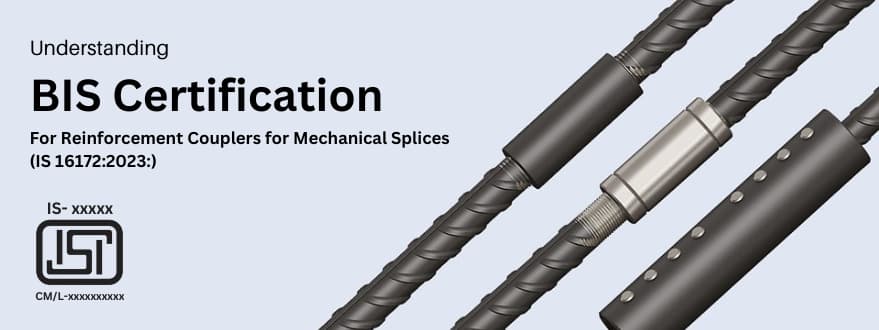
A reinforcement coupler is basically a component that is used to mechanically connect two reinforcement bars. Instead of overlapping the bars over a long length, the coupler joins their ends through an approved mechanical connection. These couplers can be quite useful in high-rise buildings, bridges, industrial structures, as well as various other reinforced concrete projects. Mechanical splicing can reduce reinforcement congestion where traditional lapping is almost impossible.
IS 16172:2023 covers reinforcement couplers that are used for mechanical splicing of steel bars in concrete. The standard generally applies to reinforcement bars that are conforming to IS 1786 and includes different coupler arrangements, including hybrid as well as transition couplers.
BIS QCO 2025 for Reinforcement Couplers for Mechanical Splices
The Department for Promotion of Industry and Internal Trade under the GOI has recently issued a BIS QCO for reinforcement of couplers for mechanical splices. According to this Order, the reinforcement couplers are required to mandatorily obtain an ISI mark under the BIS guidelines in order to be sold or imported in the Indian market. Non-compliance with this order may cause legal penalties as well as fines. Therefore, businesses selling or importing the notified products in India have to abide by the ISI mark regulations.
Understanding IS 16172:2023 in detail
IS 16172:2023 is the first revision of the earlier 2014 standard. The revised version expanded the scope in order to address a wider range of reinforcement bars and applications.
The standard actually covers important aspects such as classification, manufacture, workmanship and finish, nominal sizes, performance requirements, sampling, conformity criteria, packing, rust prevention, as well as marking requirements.
It also recognises Class H and Class L couplers. Class H couplers meet both low-cycle and high-cycle fatigue requirements, while Class L couplers meet the applicable low-cycle fatigue requirement.
What Tests are required for Reinforcement Couplers?
Testing is definitely a major part of BIS certification because the coupler must demonstrate that it can perform reliably under specified conditions. Depending on the applicable scope, testing can include the following parameters:
- Static tensile strength
- Disengagement testing for threaded couplers
- Percentage elongation
- Slip testing
- Cyclic tensile testing
- Low-cycle fatigue testing
- High-cycle fatigue testing
- Workmanship and finish checks
- Verification of nominal sizes and other specified requirements
Manufacturers as well as importers of reinforcement couplers must make sure that the products meet the testing parameters and are eligible in the Indian market. If you are not sure what technical requirements are needed, check your product’s eligibility for a BIS certification today.
Why is BIS Certification Important?
A reinforcement coupler is not simply a metal fitting. Its performance can actually influence the continuity as well as the behaviour of reinforcement in a concrete structure. A poor-quality or incorrectly manufactured coupler may create problems at the connection point.
BIS certification provides a structured conformity assessment procedure against the applicable Indian Standard. For products that have been notified by a compulsory certification requirement, manufacturers must meet the applicable BIS requirements before selling or importing the products in the Indian market.
Certification also helps manufacturers demonstrate that their production controls as well as products have been checked against relevant requirements. Partnering with a top BIS ISI certification consultant in India can simplify the entire process for an ISI mark license.
BIS Certification Process for Reinforcement Couplers
Here is a step-by-step process to easily obtain a BIS certification for reinforcement couplers:
- Preparation of the Documents
The applicant should prepare the documents as per the prescribed checklist. For foreign manufacturers, an Authorized Indian Representative (AIR) must be appointed to proceed with the application. - Submission of the Application
The applicant needs to submit the application to the BIS authorities to initiate the certification process. - Factory Inspections by BIS Officials
The BIS officials will visit the factory to conduct factory inspections to review the manufacturing processes and quality assurance as per BIS Standards. - Product Testing
The product sample will be tested in BIS-accredited laboratories, as per relevant standards. The product sample will be decided (chosen) by a BIS officer during the inspection. - Grant of BIS ISI Certification
After verifying the details, credibility, and audit report, the BIS ISI certification will be granted to the applicant. If you are a foreign manufacturer, the ISI mark license will be granted under the FMCS.
Note: The process for BIS ISI certification for domestic manufacturers differs from the FMCS process for foreign manufacturers.
What are the Required Documents for BIS ISI certification?
Manufacturers should keep their technical as well as business records organised before submitting an application. Here are the commonly required documents for a BIS ISI license:
- Legal address proofs of the factories
- Product specification
- Details of raw material, machinery, and testing equipments
- Details of QC Staff and other basic details of the factory
- Lab test reports of the product
- Main Application Form V
- ISI Application Fee
- Appointment of AIR (Authorized Indian Representative) in case you are a foreign manufacturer
Note: You can appoint Brand Liaison, the best BIS ISI certificate consultant in Delhi, as your AIR.
BIS Marking and Post-Certification Compliance
Once certification is granted, the manufacturer must use the Standard Mark only in the manner that has been permitted by BIS and within the approved licence scope. Product marking and related information must follow the applicable requirements.
Moreover, businesses should understand that certification is not a one-time exercise where quality can be ignored after the licence is issued. Manufacturers must continue producing conforming products, maintain required quality controls and cooperate with surveillance or other BIS activities as applicable.
If there are changes in product design, manufacturing arrangements, sizes, materials or several other important parameters, the manufacturer should first check whether BIS approval, testing or a change in licence scope is required.
BIS Compliance for Imported or Foreign-Manufactured Couplers
Foreign manufacturers who are supplying reinforcement couplers to India should not assume that an overseas test report or certification replaces Indian BIS requirements. Where compulsory BIS certification applies, the foreign manufacturer must follow the applicable BIS FMCS procedure and demonstrate conformity with the Indian Standard.
The certification approach for a foreign factory can certainly differ from that for an Indian manufacturer. Businesses should therefore determine the applicable BIS Scheme, representative requirements, testing arrangements, as well as the factory assessment requirements before planning imports for the Indian market.
Common Compliance Mistakes to Avoid
Several avoidable issues can delay certification. These include the following:
- Selecting the wrong product scope
- Beginning testing before confirming the applicable requirements
- Submitting incomplete documents
- Having inadequate in-house testing arrangements
- Inconsistent product specifications
- Failing to prepare the factory for inspection
- Treating all sizes or coupler types as automatically covered by one licence
Why Choose a Trusted BIS Consultant?
BIS certification combines technical, testing, documentation, as well as regulatory requirements. Manufacturers may find it difficult to coordinate all these stages while managing normal production activities.
A professional BIS consultant can help identify the applicable certification scheme, review the product against the specified Indian standard, coordinate testing, organise documents, prepare the factory for inspection, as well as assist in responding to BIS observations.
The main advantage is not simply paperwork support. Early technical as well as regulatory review can help identify gaps before they cause testing failures, application delays or unexpected costs.
How Brand Liaison Helps?
Brand Liaison, having 10+ years of experience in product certifications and approvals for the Indian market, supports manufacturers through the BIS certification process for reinforcement couplers by providing structured assistance from initial assessment to the grant of certification.
Our support generally includes standard and scope identification, documentation review, testing coordination, application assistance, factory inspection preparation, and support for resolving compliance observations. We also help businesses understand what needs to be prepared before they approach the certification stage.
For manufacturers who are planning to supply the Indian market, we can make the process easier to manage and reduce avoidable compliance gaps. Contact our team of professionals today and start your journey towards hassle-free compliance.
Conclusion
Reinforcement couplers play an absolutely important role in modern reinforced concrete construction, particularly where mechanical splicing can offer practical advantages over conventional methods. IS 16172:2023 provides the technical framework for reinforcement couplers that are used with steel bars in concrete and sets requirements for performance, testing, conformity and quality control.
For manufacturers, the right approach is to confirm the applicable certification requirement and product scope first, then prepare the factory, documentation and testing arrangements accordingly. Professional BIS support can definitely help businesses move through these stages with greater clarity and fewer avoidable errors.









Share Your Views
Add a Comment