For Indian Market
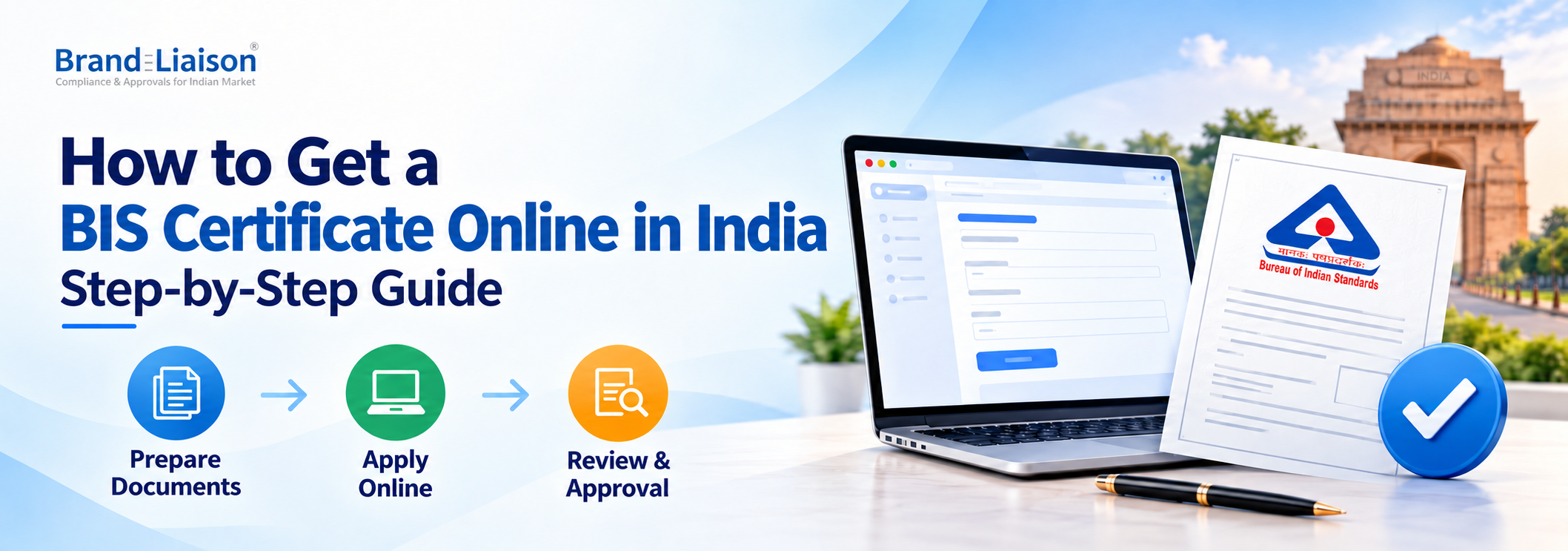
How to Get a BIS Certificate Online in India: Step-by-Step Guide
Introduction
If you manufacture, import, sell, or plan to introduce a product in the Indian market, especially if it is notified for mandatory compliance, you may have come across the term BIS certification. For many businesses, the next question is simple: How can I get a BIS certificate online? The good news is that BIS has moved a large part of its application process online.
Manufacturers can submit applications, upload documents, make payments, as well as easily track their applications through the relevant BIS online portal. However, getting a BIS certificate is not simply a matter of filling out an online form. The first and most important step is to understand which BIS scheme applies to your product.
This “BIS certificate online apply” guide explains the complete process in simple language so that a manufacturer or business owner can understand what needs to be done before, during, and after applying online.
What is a BIS Certificate?
A BIS certificate is a mandatory compliance certificate for all notified products that are being sold or imported in the Indian market. It is mainly administered by the Bureau of Indian Standards (BIS). BIS is India's national standards body. It develops and maintains Indian Standards and performance benchmarks, and operates different BIS certification schemes through which manufacturers can demonstrate that their products meet specified requirements to be eligible for sales in the Indian market.
Depending on the product, BIS compliance may allow a manufacturer to use the applicable BIS Standard Mark, obtain a registration with an R-number, or receive a Certificate of Conformity.
One important point is that there is no single BIS certificate that applies to every product.
Is BIS Certification Mandatory for Every Product?
No. BIS certification is not mandatory for every product in India. However, the Central Government can make compliance compulsory for specific products through Quality Control Orders and other notifications for various reasons such as public safety, environmental protection, consumer protection, health, as well as national security.
This means that two products may have completely different compliance requirements.
For example, one product may require a BIS licence under Scheme-I, another electronic product may fall under CRS, while a specified machinery or electrical product may require certification under Scheme-X.
The applicable BIS certification scheme type generally depends on different factors such as:
- Product category
- Applicable Indian Standard
- Manufacturing location
- Whether the product is covered by a QCO
- Whether the manufacturer is Indian or foreign
- Applicable BIS conformity assessment scheme
- Product-specific testing and certification requirements
So, before searching for a "BIS certificate online application form", it is important to identify the correct BIS process for your product.
Which BIS Scheme Do You Need?
BIS operates different certification and licensing schemes. Some of the most relevant BIS registration types for businesses include the following:
1. BIS Scheme-I - ISI Mark Certification
Scheme-I is the traditional BIS product certification scheme that is associated with the use of the ISI Mark. It basically applies to products that have been notified under relevant Indian Standards and regulatory requirements.
Under this process, BIS evaluates the manufacturer's manufacturing infrastructure, process controls, quality control, as well as testing capabilities. Product conformity is established through applicable testing requirements.
BIS ISI certification is commonly relevant to manufacturers of products such as:
- Building materials
- Electrical products
- Steel products
- Cement and related products
- Household products
- Mechanical products
- Certain chemical products
- Other products covered by applicable BIS requirements
2. BIS CRS - Compulsory Registration Scheme
The Compulsory Registration Scheme (CRS) is mainly used for specified electronic as well as IT products. Unlike a conventional BIS ISI Mark licence, BIS CRS Registration involves registration of the applicable product that is based on conformity with the relevant standard as well as the prescribed testing requirements.
Examples of products that require a mandatory BIS CRS registration generally include:
- Electronic equipment
- IT products
- Consumer electronics
- Power supplies
- Certain display products
- Other products notified under the applicable CRS order
Manufacturers must carefully understand the BIS registration in detail and know the requirements to stay compliant with BIS regulations in the Indian market.
3. BIS Scheme X Certification
The BIS Scheme-X certification applies to certain products that have been notified for compulsory BIS certification under the applicable regulatory framework. It is particularly important for specified machinery and electrical equipment categories, notified for mandatory compliance in India.
BIS maintains a dedicated Scheme-X framework, including product-specific guidelines and registration routes for applicable products.
4. BIS FMCS for Foreign Manufacturers
If the manufacturer is located outside India, the applicable BIS scheme will be the Foreign Manufacturers Certification Scheme (FMCS). Foreign manufacturers must meet the relevant Indian Standard requirements and have the necessary manufacturing and testing facilities. They are also required to appoint an Authorized Indian Representative (AIR) as prescribed under the scheme.
How to Get a BIS Certificate Online?
Once you know the correct scheme and standard, the actual application journey becomes absolutely easier to understand. Here is the process in simple steps that must be followed by businesses to get a BIS certificate online:
Step 1: Check Whether Your Product Requires BIS Certification
It is important that you do not start by creating an application. First, check whether your product requires the mandatory certificate. You can check your eligibility for a BIS certification today to know the key compliance requirements.
Step 2: Identify the Correct Indian Standard
After determining that BIS certification or registration applies, it is essential to identify the Indian Standard (IS) applicable to your product. This is one of the most important steps in the entire process. The Indian Standard determines many later requirements, including testing, quality-control, marking requirements, etc.
Step 3: Check the Product Manual and BIS Requirements
Once the applicable standard is identified, do not immediately submit the application.
Review the relevant scheme requirements, testing parameters, machinery performance criteria, documentation, etc.
Step 4: Make Sure Your Manufacturing Facility Is Ready
A BIS application is not only about paperwork. For many BIS certification schemes, BIS also evaluates whether the manufacturer actually has the capability to produce a product consistently according to the applicable Indian Standard.
BIS actually wants to see not only that your product passes a test, but that your manufacturing system is capable of consistently producing compliant products.
Step 5: Prepare the BIS Documents
The exact document checklist changes according to the product and BIS scheme, but businesses should generally be prepared with the commonly asked documents such as:
- Manufacturer's legal name
- Factory address
- Business registration details
- Product and technical details
- Brand/trademark information
- Testing equipment details
- Quality-control arrangements
- Test reports
- Raw-material details
- Undertakings and declarations
- Authorisation and representation documents (in case of foreign manufacturers)
It is important to prepare the documents as per the prescribed format, in order to reduce last-minute errors and hassles in BIS applications.
Step 6: Create an Account on the BIS Online Portal
BIS product certification applications are submitted online through the official BIS portal. The basic process after visiting the portal generally involves the following steps:
- Visit the applicable BIS online portal (Manakonline Portal for ISI, Scheme X and FMCS; CRS portal for BIS CRS Registration).
- Create an applicant/manufacturer account.
- Enter the required business details.
- Verify the account and log in.
- Select the relevant certification or registration option.
- Select the applicable product and Indian Standard.
- Complete the online application.
- Upload the required documents.
- Pay the applicable fees.
- Submit the application and track the status of the same.
The exact fields and modules can vary depending on the BIS scheme type.
Step 7: Before clicking "Submit", check details
- Is the manufacturer's legal name correct?
- Is the factory address accurate?
- Is the correct IS number selected?
- Are product models correctly listed?
- Are manufacturing facilities correctly declared?
- Are testing facilities available as required?
- Are uploaded documents readable?
- Do all documents carry consistent information?
Step 8: Upload the Required Documents
The next stage is uploading the prescribed documents that have been specified for the particular application. Make sure that the documents are clear, complete, correct, and properly signed, within the prescribed format and size.
Step 9: Pay the Applicable BIS Fees Online
BIS certification involves applicable government fees, but there is no single fixed BIS certification fee for every product. The cost varies depending on several factors such as testing charges, marking fees, and additional compliance requirements, etc.
Step 10: Submit the Application and Track It Online
After completing the application, uploading documents, and making the required payment, submit the application through the portal. After verifying the credibility and details submitted, the BIS grants the license. Applicants can download the BIS certificate and proceed with the business operations in the Indian market.
What Happens After You Apply for BIS Certification?
Submitting the online form is not the end of the BIS process. What happens next depends on the applicable scheme. For many product certification applications, the process can include testing as well as factory inspections. Let's understand these stages in detail:
BIS Factory Inspection
For applicable certification schemes, BIS may conduct an evaluation of the manufacturing premises. During the inspection, areas such as the following may be checked by the BIS officials:
- Manufacturing machinery
- Production process
- Quality-control and raw-material system
- Testing facilities and equipment
- Staff and other details
- Product samples
BIS confirms that the manufacturer has the necessary infrastructure as well as the capabilities before granting the applicable licence.
BIS Product Testing
Testing is one of the most important parts of BIS compliance. The product may need to be tested against the requirements of the applicable Indian Standard, in order to ensure that it meets the safety and performance benchmarks to be compliant for sales in India. Depending on the scheme as well as the product, testing may be performed through:
- BIS-recognised laboratories
- Manufacturer's in-house testing facilities
- Third-party laboratories
- A combination of applicable testing arrangements
A top BIS certification consultant in India can help you with absolute technical assistance and make your BIS compliance journey a lot smoother.
What If BIS Raises a Query?
For businesses seeking BIS compliance for notified products in India, it is important that they do not panic if BIS raises a query. Queries are a normal part of regulatory applications. A query may ask you to:
- Correct information
- Upload a missing document
- Explain a technical point
- Submit an additional record
- Clarify product specifications
- Correct an inconsistency
- Provide additional evidence of compliance
The important thing is to respond accurately and within the prescribed time. An incomplete or unclear response can definitely result in another query and extend the overall certification process.
Thus, taking help from expert professionals and an experienced BIS Consultant can help in simplifying BIS compliance for businesses.
When is the BIS Certificate or Licence Granted?
Once the applicable requirements have been completed, including evaluation by the BIS officials and testing of the product samples, if required by a BIS scheme, BIS can grant the applicable licence, registration or certificate to the applicant.
Here is a general estimated timeline to get a BIS certification in India:
- ISI mark certification (domestic manufacturers): 20-40 working days
- FMCS certification (foreign manufacturers): 5-6 months
- BIS CRS Registration: 25-40 working days
- Scheme X license: 2-6 months
After approval, the manufacturer must continue to follow the applicable BIS requirements, as part of ongoing certification compliance.
What is the Cost of Getting a BIS Certificate Online?
The total cost depends on the certification type and BIS Scheme. Generally, businesses may need to consider the following factors while considering the BIS certification cost:
- BIS application fee
- Testing/laboratory charges
- Inspection charges, where applicable
- Licence fee
- Marking fee, where applicable
- Renewal-related fees
- Consultant or professional charges, if used
- Product sample and logistics costs
- Factory preparation costs, if improvements are required
The cost may vary, and for getting an exact price and BIS certification fee, it is best to contact the best BIS certification consultant - Brand Liaison.
Common Mistakes to Avoid When Applying for BIS Online
Many BIS applications often become difficult and complicated not because the certification is impossible, but because the preparation is incomplete. Here are some common mistakes businesses should avoid:
- Selecting the wrong Indian Standard
This can affect the entire application and testing process, leading to application rejection. - Applying before checking the QCO
A product may have a mandatory compliance date that businesses need to plan for in advance. - Treating BIS as only a document process
For applicable BIS schemes, factory readiness as well as product testing are equally important. - Uploading inconsistent documents
Differences in company names, addresses, product descriptions, or model numbers can create queries by the BIS officials. - Ignoring product variants
Different models or variants may not always be covered in the same way, and ignoring them can lead to further work in making the application appropriate. - Using an outdated test report
Always check whether the test report meets the current applicable requirements, or else there will be a need to spend money again on lab testing charges. - Delaying replies to BIS queries
A pending query can hold up the application and lead to further delays in the BIS certification process. - Assuming every BIS application follows the same process
Scheme-I, CRS, Scheme-X and FMCS have different requirements, and the process to get the certification for each of them is different. - Looking only at the application fee
Testing, inspection, marking as well as various other applicable charges can contribute to the overall cost. - Preparing the factory only after applying
For schemes involving factory evaluation, it is much better to identify gaps before application submission.
Brand Liaison - Your Compliance Partner for BIS Certification in India
Brand Liaison India Pvt. Ltd., being the best BIS certification consultant in Delhi, India, provides end-to-end assistance for businesses that are looking to obtain BIS registration in India. With more than a decade of experience in regulatory compliance and 500+ brands served, the team helps manufacturers understand the applicable BIS requirements and navigate the certification process with greater clarity.
Here is how Brand Liaison helps businesses:
- BIS applicability assessment
- Dedicated guidebooks to understand BIS and other Indian market approvals
- Cost-effective solutions
- Practical compliance management
- Expert certification consultancy
- AIR support for foreign manufacturers
- Post-grant assistance
- Technical documentation support
- Comprehensive BIS assistance for businesses
Being the most trusted BIS certification consultants in India, Brand Liaison helps in simplifying the regulatory requirements for businesses with utmost ease and efficiency. Contact us today and initiate BIS registration in a hassle-free manner.
Conclusion
The online BIS application has made the filing process more convenient, but BIS certification itself remains a compliance exercise, not simply an online registration for businesses operating in India. If you are unsure whether your product requires BIS certification, which BIS scheme applies, which IS code to select, or what documents and testing are required, getting in touch with Brand Liaison, a professional BIS consultant, before filing can help avoid unnecessary costs as well as certification delays.
Frequently Asked Questions
Can an importer apply for a BIS certificate instead of the manufacturer?
Can one BIS licence cover products manufactured at different factories?
Can a BIS certificate be transferred from one manufacturer to another?
Does getting a BIS certificate mean the product can be sold anywhere in India?
Can a BIS application be rejected even if the product passes the laboratory test?
Is BIS certification required again if the Indian Standard is revised?
Why Choose Brand Liaison?
Brand Liaison is a professional product compliance consultancy firm making product certification simple and easy for manufacturers and importers.
- 10+ Years of BIS Certification Experience
- 5000+ Certifications Delivered Globally
- Dedicated Teams for CRS, FMCS & ISI Mark
- End-to-End Documentation & Filing Support
- Fast Response & Practical Compliance Guidance
- Support for Indian & Foreign Manufacturers
At Brand Liaison, our expert team helps the businesses to get the certification approvals faster for sale and import of notified products.
Get Free Consultation
Testimonials
What our client says

Brand Liaison is a trusted partner for all our certification needs. Their expert team made the complicated compliance process simple and stress-free. Professional, reliable, and highly efficient.

Sylvester Adams

Our experience with Brand Liaison has been outstanding. From start to finish, their consultants managed everything with precision. The professionalism and expertise of their team are truly commendable.

Pratibha Mukhija

Brand Liaison has an excellent team of experts who know the compliance field inside out. Their commitment, transparency, and professional service make them stand out from others.

Ashish Banerjee

We were struggling with BIS certification until we connected with Brand Liaison. Their knowledgeable team guided us with accuracy and patience. Excellent service and very professional staff.

Christina Gomez

The expertise of Brand Liaison’s consultants is evident in how quickly and efficiently they work. They saved us time, effort, and unnecessary stress. Highly recommended for compliance services.

Varun Shukla

What impressed us most about Brand Liaison is their professional approach and in-depth knowledge. The team is always available to answer queries and provide reliable guidance throughout the process.

Sanchi Gupta

We trusted Brand Liaison with our BEE certification, and they delivered perfectly. Their expert handling of documentation and testing was seamless. A great team with unmatched professionalism.

George Jacob

Brand Liaison made the entire certification process smooth and simple. Their team explained every step clearly and handled all requirements with complete professionalism. Truly experts in their field.